









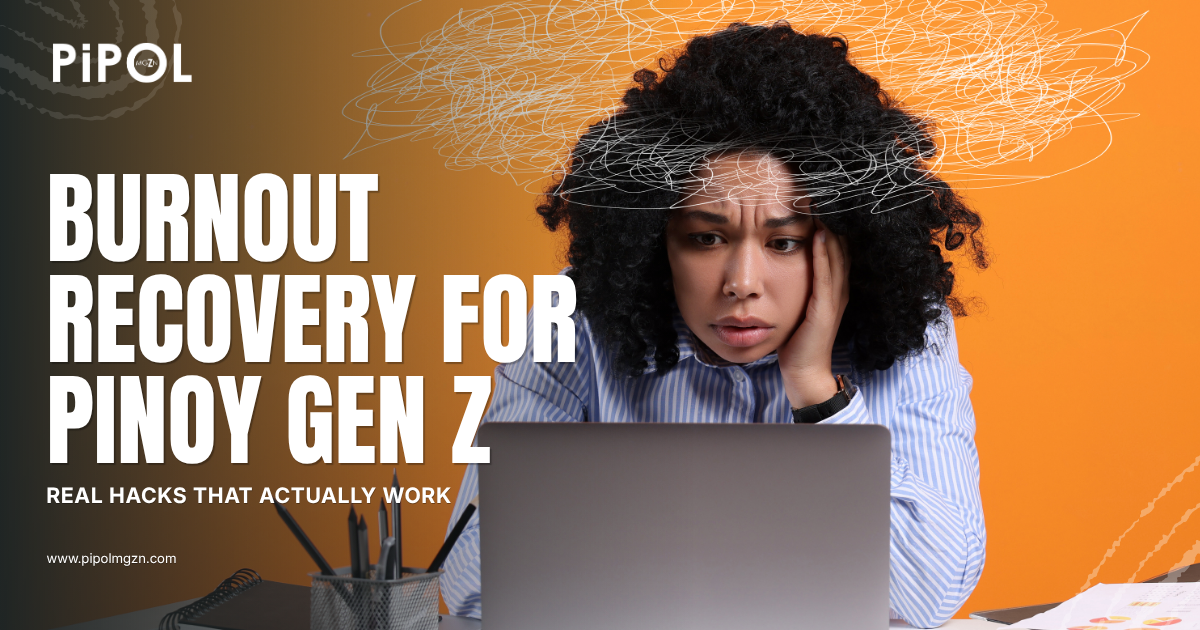
Burnout Recovery for Pinoy Gen Z: Real Hacks That Actually Work

If you’ve ever sat in front of your laptop at 2 a.m.—drained, foggy, but somehow unable to stop—you already know the feeling. The World Health Organization defines burnout as a syndrome born from “chronic workplace stress that has not been successfully managed”: exhaustion, cynicism, and the nagging sense that nothing you do is ever enough. For many in Gen Z, that isn’t an occasional bad week. It’s the baseline.
The numbers are sobering. Deloitte’s 2025 survey of more than 23,000 young people found that 40% of Gen Zs feel stressed or anxious almost all of the time. Here at home it runs heavier: the Philippines posts one of the highest burnout rates in Southeast Asia, and reports show young Filipino workers—especially those aged 18 to 24—are hit hardest by stress and anxiety. Blame long hours, hustle culture, and the quiet weight of providing for family.
Here’s the better news: recovery is real, and it’s backed by science. You don’t need to quit your job or fly off to Siargao. You need small, repeatable habits—five of them, in particular.
1. Unplug for real
Psychologists call it psychological detachment: mentally and physically switching off from work once the day is done. Research ranks it among the strongest buffers against burnout, because the problem isn’t only that you work hard—it’s that your brain never clocks out. Set a hard logoff time, mute work chats after hours, and keep your phone out of the bedroom. Detachment isn’t laziness; it’s maintenance. The mind, like any overused muscle, only rebuilds during genuine rest—not while it’s still bracing for the next notification.
2. Guard your sleep like a deadline
Poor sleep both causes and deepens burnout, which is why researchers treat consistent rest as central to recovery. The fix is less about more hours and more about rhythm: a steady sleep and wake time, even on weekends, resets the body’s stress system. Dim the screens an hour before bed—blue light tricks your brain into thinking it’s still daytime—and treat your wind-down with the same seriousness you’d give a work deadline. One good night won’t erase exhaustion, but a fortnight of them genuinely begins to.
3. Move, even just a little
You don’t need a gym membership or a marathon plan. Exercise releases endorphins—the body’s natural mood lifters—and even a brisk twenty-minute walk measurably lowers stress hormones. Movement also improves sleep and breaks the all-day sitting that quietly feeds fatigue. Make it easy and social: walk with a friend, dance to one playlist, take the stairs. The goal isn’t fitness for its own sake—it’s giving your nervous system a regular, gentle signal that you are safe, and the danger has passed.
4. Lean on your barkada
Isolation makes burnout worse; connection helps undo it. Strong social support restores energy, sharpens focus, and speeds recovery—and Filipinos have always known this instinctively. It’s the diskarte our titas swear by: the tawag sa barkada, the kwentuhan over kape, the simple act of saying the quiet part out loud to someone who gets it. You don’t need a grand confession. A single honest check-in a day—“uy, kumusta ka talaga?”—reminds your overworked brain that you are not carrying everything alone.
5. Try mindfulness—five minutes counts
Mindfulness—paying gentle, non-judgmental attention to the present—has been shown across repeated studies to reduce burnout, especially among high-pressure workers. It sounds abstract, but the practice is concrete: five minutes of slow breathing, a short guided meditation on your phone, or simply eating lunch without scrolling. The point isn’t to empty your mind—it’s to stop your thoughts from sprinting toward every deadline at once. Done daily, it teaches your body the one skill burnout erases: how to be still.
Take Mara, a 24-year-old content creator in Manila who hit a wall last year. Her turnaround wasn’t cinematic—no dramatic resignation, no escape to the islands. She set a hard 7 p.m. logoff, walked every morning, texted one friend a day, and breathed for five minutes before bed. Within weeks, the fog began to lift. Small, repeatable, human.
Burnout doesn’t mean you’re weak. It means you’ve been strong for too long without rest. Healing rarely looks like a grand reset—it looks like one boundary held, one good night’s sleep, one honest conversation. So start there, kaibigan. You’re allowed to slow down. Your worth was never measured in output, and rest isn’t quitting—it’s how you keep going.
Sources & References
World Health Organization, “Burn-out an ‘occupational phenomenon’: International Classification of Diseases” (ICD-11), 2019. https://www.who.int/news/item/28-05-2019-burn-out-an-occupational-phenomenon-international-classification-of-diseases
Deloitte, “2025 Gen Z and Millennial Survey,” Deloitte Insights, 2025. https://www.deloitte.com/us/en/insights/topics/talent/2025-gen-z-millennial-survey.html
Suwanwong et al., “Prevalence and associated factors of burnout among working adults in Southeast Asia,” Frontiers in Public Health, 2024. https://www.frontiersin.org/journals/public-health/articles/10.3389/fpubh.2024.1326227/full
AXA Philippines, “AXA Mind Health Report 2024.” https://www.axa.com.ph/multimedia/newsroom/axa-ph-shares-axa-mind-health-report-2024
PositivePsychology.com, “Burnout Recovery Plan: 14 Exercises & Treatments” (psychological detachment, sleep, exercise, social support). https://positivepsychology.com/how-to-recover-burnout/
Inspire the Mind, “Eight evidence-based approaches to beat burnout” (mindfulness; Luken & Sammons, 2016). https://www.inspirethemind.org/post/eight-evidence-based-approaches-to-beat-burnout








No Comment! Be the first one.